I bought a few winter outfits over the holidays at WalMart. The baby Faded Glory stuff is $5 (some of it $4 on clearance). They have khakis, jeans, long sleeve dress shirts and thermal shirts. Don't go by the size info on the tag because it says they run small, but they actually run a size larger.
My almost 12 month old son is 30" tall and about 25 pounds. The 12 month shirts fit him like a normal shirt and the 18 months are a little big. I didn't try the 12 month pants because his cloth diapers are poofy, but the 18 month pants have a little growing room without being overwhelming even with disposables. The 24 month pair of pants I bought him was so long (fit more like a 2t or 3t in other brands) that it needed serious hemming, and the waist is pretty big but not so much that they fall off with normal movement. What partly threw me off was that most baby clothes shrink A LOT, but these didn't shrink that much. Other pluses: they're supposedly 70-100% organic cotton depending on the item, they aren't made in China.
The selection isn't huge, but you can't beat the price (especially for organic) if you're looking for a few basics for your baby's wardrobe that you'll be able to mix and match with other clothing.

Showing posts with label money savers. Show all posts
Showing posts with label money savers. Show all posts
Thursday, January 20, 2011

Friday, November 5, 2010
Top 5 Humidifiers
The Dilemma
Discovered on last week that it's time to get a new humidifier. We have a Vicks Cool Mist, which is an evaporative model. It really wasn't that great after the first month or so. It's expensive to operate as it needs a wicking filter every month or so depending on your water($9-12 unless there's a sale). While the cleaning cartridge (demineralizer) is optional, it seems based on my experience without it that you really do need it, but the good news about the cleaning cartridge is that the Protec PC1 cartridge is reusable for up to 30 days as long as it is allowed to dry out so that one can potentially be a really good value as long as you don't forget and throw it away. In addition to evaporative humidifiers not being as efficient or effective at raising the humidity, the Vicks 1 Gallon Cool Mist is hard to clean because the reservoir has an off-centered, bottleneck opening which makes it impossible to scrub the film and buildup that isn't immediately adjacent. A smell developed a few weeks ago, and I couldn't figure out where it was coming from. I totally took it apart and found that the inside of the motor housing was filthy from sucking in air and perhaps growing mold but I couldn't tell for sure without opening it. Of course, the housing isn't removable. I was able to clean it with a can of compressed air and a day in the sun, all is well. The smell is gone and everything is back to normal, but I never want to deal with that again.
The humidifier was a gift, and I always planned to replace with a better one because I wanted one that made less waste (little to no filter/cartridge replacements) and was easier to do a thorough cleaning on, and I prefer one that can do both cool and warm mist because there are times when warm mist is more effective but for every day use cool mist is usually preferred.
Anyway, I thought I'd share my humidifier research since it's the time of year when a lot of people need them. These are the top 5 I've found for function, noise level, low maintenance, and sterility with sterility and low maintenance being my most desired traits. All of them are easy to find at the usual places (drug stores, Amazon, Walmart, Target, Diapers.com, etc.) except the Coway, my top choice. The price listed is the cheapest I found online for each humidifier.
The Research
1) Coway MHS-E5010 (aka Coway HC WJ ONYX) - $125 at www.newbidet.com
From what I've found, this is the proverbial Cadillac of humidifiers. This dual mist warm/cold ultrasonic humidifer has a 5-stage purification process that ensures the cleanest air and water is being released from the machine and produces the finest mist of all the humidifiers I looked at. The tank and tray implement nano silver technology to prevent the growth of bacteria, mold, and microbes. The air intake is also lined with nano silver to purify the air as it enters the humidifer. You can fill the tank from openings in the top and bottom of the tank so you don't have to turn it upside down, and it makes it easier to clean since you have access from both sides. If this isn't enough, it also has various settings including sleep mode, child mode, health mode, and sanitization mode so you have a setting for every need that should arise. It is a fairly compact model, with a 1.3 gallon tank. The description says this lasts 12 hours, which is probably an understatement because other one-gallon tanks usually last 18-24 hours. This is probably the water usage on the warm setting. Either way, it's more than enough to get through a night's sleep, and it's best to replace the water in every humidifier daily for sanitation purposes. In short, this humidifier does more than most that cost even twice as much. When my budget allows, this is the one I'll be getting. For more detailed information, click the Amazon or NewBidet.com links.
2) Germ Guardian H1500 Ultrasonic Humidifier - $100
If you don't want one with all the bells and whistles but still want some nice features, need one to fit a smaller budget, or are more comfortable with analog rather than digital controls, the Germ Guardian is for you. You still get the dual warm and cool mist, a tank that lasts ups 20 hours, a low water indicator, and nano silver cleaning, in a filterless and silent machine. Germ Guardian has a great reputation and a 3 year warranty to back up their products and makes a number of products for improving the sanitation in your home including toothbrush sterilizers, air purifiers, and uv light sterilizers. For more money, they make digital models and humidifiers with more features like variable mist control, adjustable spray, and humidity auto-adjustment. Or for as low as $48, they also have a table top model that humidifies your personal space and can be used beside your bed and on your office desk for short-distance humidification that doesn't alter a whole room's humidity.
that humidifies your personal space and can be used beside your bed and on your office desk for short-distance humidification that doesn't alter a whole room's humidity.3) Sunpentown SPT SU-4010 Dual Mist Humidifier with Ion Exchange Filter - $75
This very slim model is equipped with warm and cool mist, adjustable split nozzle for bi-directional mist control, overheat protection, and it's own cleaning brush. The water tank lasts about 10 hours on high in the warm setting, which uses 90 watts, and 12 hours on the highest cool setting, which is 43 watts. While this is not a filterless model, the filter it uses (SPT ION F-4010) only needs replacing every six months or so. And the filter does double duty to demineralize the water in addition to removing particulates. The one downside is that because it's so thin, it can tip over easily if pets or children can reach it. Make sure to keep it out of reach of curious little hands and paws.
4) Vicks UV 99.999% Germ Free Humidifier - $68
This warm mist model features dual water tanks that function independently of each other, so one side empties before the other which allows you to refill it without having to shut off the machine. The smaller tanks are easier to handle during refills and cleaning. No filter is required on this one, but a demineralizer like the Protec cleaning cartridge or Honeywell mineral absorption pad
 are recommended. A special UV chamber kills 99.999% of all bacteria, mold, and spores so the water vapors released are about as sterile as it gets. This machine also has adjustable humidity and mist output settings that you can customize to suit your needs. Since this is a warm mist model, however, users must take care to not let the unit run dry or it will boil itself out. Some reviewers have complained that the UV chamber leaks very bright light. Because of the temperature necessary to create the steam mist, the UV chamber seems superfluous. A UV cool mist model like this Honeywell
 would make more sense, but I haven't seen one with good reviews and all the models I saw require filters. People in general seem to like this Vicks model though.
or Honeywell mineral absorption pad are recommended. A special UV chamber kills 99.999% of all bacteria, mold, and spores so the water vapors released are about as sterile as it gets. This machine also has adjustable humidity and mist output settings that you can customize to suit your needs. Since this is a warm mist model, however, users must take care to not let the unit run dry or it will boil itself out. Some reviewers have complained that the UV chamber leaks very bright light. Because of the temperature necessary to create the steam mist, the UV chamber seems superfluous. A UV cool mist model like this Honeywell would make more sense, but I haven't seen one with good reviews and all the models I saw require filters. People in general seem to like this Vicks model though.5) Crane Cool Mist Humidifier - $30-45
For an inexpensive, no fuss humidifier with consistently good ratings, the road stops here. Cranes are dependable, easy to use, and easy to maintain. No filters are required, but you may want to use a dimineralizer especially if your water is hard. These models are cool mist only and come in other colors besides the typical blue and white fair. For the little ones, they make the line of Adorable 1 Gallon Humidifiers in cute animal shapes, and they even make Sponge Bob and Thomas the Train humidifiers. If you want the extra antibacterial protection with less expensive humidifiers, you can use Protec Cleaning Cartridges which are actually reusable for 30 days as long as they are allowed to dry out between uses. A 2-pack is perfect for this because you can take the wet one out during your weekly or biweekly tank maintenance and put the dry one in when you refill the tank. There are also chemical additives that are supposedly safe for use in cool mist humidifiers like Holmes Bacteriostat
 but I would stay away from them as they have pretty serious warnings about contact with skin and accidental ingestion.
in cute animal shapes, and they even make Sponge Bob and Thomas the Train humidifiers. If you want the extra antibacterial protection with less expensive humidifiers, you can use Protec Cleaning Cartridges which are actually reusable for 30 days as long as they are allowed to dry out between uses. A 2-pack is perfect for this because you can take the wet one out during your weekly or biweekly tank maintenance and put the dry one in when you refill the tank. There are also chemical additives that are supposedly safe for use in cool mist humidifiers like Holmes Bacteriostat but I would stay away from them as they have pretty serious warnings about contact with skin and accidental ingestion.The Longevity (aka How to Get the Most out of your Humidifier)
With all humidifiers, you'll get the best performance with regular maintenance. It is recommended to change to empty the reservoirs, rinse, and refill with fresh water every day. If you use tap water, you may need or want to use cleaning cartridges to prevent mineral buildups. You should soak the tank and basin or tray weekly with a white vinegar solution (Crane recommends 1/2 gallon water and 2 tablespoons vinegar) for 20-30 minutes to disinfect and remove deposits. Some recommend a bleach solution, but I prefer to use less harsh treatments. When not in use (end of season storage, vacations, etc.), the humidifier should be cleaned with the vinegar (or bleach) solution and allowed to air dry completely. If you use a humidifier with a filter or cartridge, follow the manufacturer's directions to prevent odors, mold, mildew, and bacterial growth. Most filter and cartridge media should be replaced monthly unless otherwise specified. Regardless of what the life expectancy is for your humidifier filter, always change it when it becomes discolored or full.
Saturday, October 2, 2010
The First Years MiSwivel Feeding Chair Review
Purchased the MiSwivel Feeding Chair by The First Years a few weeks ago, and I have to say that I'm loving it. It lives up to its claims about being a chair that can go from birth to 4 years old. My son turned 8 months a few days ago, and I wish I had known about this chair sooner. We definitely could have used it. Everything about is so simple to use, install, and adjust that I didn't even have to read the manual!
by The First Years a few weeks ago, and I have to say that I'm loving it. It lives up to its claims about being a chair that can go from birth to 4 years old. My son turned 8 months a few days ago, and I wish I had known about this chair sooner. We definitely could have used it. Everything about is so simple to use, install, and adjust that I didn't even have to read the manual! |
| Alternate side of "Dot to Dot" pattern, and fits well under the table for comfortable use as a booster. |
I was looking at few different options including the Fisher Price Space Saver High Chair
 , another model that attaches to dining chairs, and a few traditional style high chairs. I ultimately chose this because it was was less expensive than high chairs with the features I wanted (washable cover, sturdy, etc.) but had more features than the Fisher Price which doesn't swivel, has fewer recline positions, doesn't fit under most dining tables because the arms are too tall, and doesn't convert into a low back booster seat.
 Overall, it was the best value I could find for my needs because it was the most versatile and had the most features for the least money. It is a little smaller than the Fisher-Price chair, so it may not last quite as long. But the smaller size is what makes it work well as a booster seat and as a travel high chair. The Fisher-Price would not have really worked for me as a booster because the arms wouldn't fit under my or my parents' dining table, so my son would be too far from the table to eat comfortably and without making a mess on the floor.
 |
| Dishwasher Safe |
- Economical seat can be used as an infant chair, feeding chair, booster seat, and travel high chair.
- The cover is reversible, easily removable, and machine washer safe. It actually came out better after washing because it was softer (I use Charlie's Soap
...it does that!) and the inner padded became fluffier.
- Reclines from 45˚-90˚. I don't use this feature that much, but I would have used it a lot if I had gotten it when he was a newborn. It is very easy to use the recline, the seat slides smoothly into position and locks securely.
- 180˚ swivel. This is really nice because our chairs are heavy, solid wood formal dining chairs and they can be cumbersome to pull out from the table. You can swivel the chair to the side and get your child out without moving the chair. The pivot is smooth, able to be used with one hand with some practice, and locks securely into position.
- Dishwasher safe tray with removable, snap on shield. It's like having 2 trays! Use the shield at breakfast and the main tray is still clean for the next meal. The smiley face imprint on the shield is a nice touch.
- Fits well under the table so it can be used without the tray for a larger eating/playing area. This is particularly useful for me because I can let my son play with his toys while the family is eating and he still gets to interact with us.
- The straps that secure the feeding chair are very long. They fit around our large dining chairs with plenty of extra left over, so the chair can be safely attached to any chair without problems. No worries when you take it with you to visit the grandparents or decide to use it at a restaurant.
- Harness converts easily from 5-point harness to 3-point lap belt. There are 2 shoulder heights to choose from.
- Converting from high chair mode to booster mode is a snap...literally. The high back snaps into place when you need it (see video demo below).
- It's a compact, space-saving solution that also travels well, especially in booster mode.
Things That Could Be Improved
- It's probably fine, but I wish the seat were a little bit bigger. My son will be able to use it for a while, but I'm concerned it might be snug before my son reaches 4 years old. The part that concerns me is the raised guard in the crotch area that keeps the child from slipping out of the chair.
- Could be made of sturdier plastic, but it is by no means flimsy.
- The shoulder harness could definitely be softer or could come with harness covers. The webbing used for the harness is stiff and sometimes cuts into my son's neck if he's in an extra wiggly mood. But he'll soon outgrow the need for the shoulder portion of the harness and it won't be an issue any more.
 |
| The crotch guard may eventually be snug, and the chair itself might be a tight fit later on. My son is currently 8 months and 23 pounds. |
Besides the obvious, it's convenient place to put him while the rest of the family is eating dinner. We put all his toys in front of him, and it allows him to interact with us during meal times without having to hold him. For younger babies, I can see this being a very comfortable and useful alternative to a bassinet, swing, or baby papasan. In full recline, it seems like it would be very comfortable for newborns. It sits up higher than the swings and papasan chair so your infant has a better view and is closer to you, and it's easier to see out of than a bassinet. If I had purchased this chair sooner, I would have used it as a place to put him while I was cooking or washing his bottles and other kitchen-related chores. If you have back troubles, the recline is perfect for bottle feeding to give you a break. It's also the perfect angle for introducing first foods to 4 and 5 month olds who can't sit up well or get tired easily.
I haven't used it for eating out or traveling yet, but I'm looking forward to taking it along with me as a more sanitary option to restaurant high chairs and booster. It fits easily in the trunk, especially since the high back snaps off and quickly reattaches when you're ready for it or can be left at home for an even more compact travel feeding chair. If you don't have a full vehicle, it can be placed in one of the seats or even the floor board if it's in booster mode.
Overall, I think this is a great feeding chair and very affordable alternative to a high chair, especially since it has so many more uses. When I purchased mine, it was on sale for $45 from Amazon, and I got free shipping. I usually see it for $45-60. Since he'll most likely be tall enough to sit at the table without it by the time he outgrows it, it's a great value because I won't need to buy a separate booster. Because I won't be buying an extra baby item and all the packaging that goes with it, I'm actually creating less post-consumer waste too!
To see a demo and all the features in action, check out this video:
Friday, September 24, 2010
Thrifty Thursday: Free Samples for Baby and You
My first post all month! It's hard to believe how crazy life has been, but it looks like things are slowing down a bit for the time being.
For new parents who aren't sure what to get or seasoned veterans curious about new baby products, today's Thrifty Thursday post features websites where you can sign up to receive coupons and free samples. The websites are all free to join.
PlanningFamily.com - Get free samples and coupons delivered to your home. You choose which brands and products interest you, so you can be sure you'll get coupons and samples you'll actually use.
FreeMania.net - Sign up for the newsletter for free baby samples, t-shirts, products for moms, coupons, and sales.
All-Free-Samples.com - Find free samples for babies, kids, parents, and caregivers. You can request the individual samples that interest you.
FreeBabyStuffOnline.com - Links to samples, coupons, contests, and giveaways.
MySavings.com - Free samples, products, magazine subscriptions and more. You can find offers for the US, Canada, Great Britain, and more.
BabiesOnline.com - Get free diaper samples, magazine trials and subscriptions, formula and baby food coupons/samples, and more.
For new parents who aren't sure what to get or seasoned veterans curious about new baby products, today's Thrifty Thursday post features websites where you can sign up to receive coupons and free samples. The websites are all free to join.
PlanningFamily.com - Get free samples and coupons delivered to your home. You choose which brands and products interest you, so you can be sure you'll get coupons and samples you'll actually use.
FreeMania.net - Sign up for the newsletter for free baby samples, t-shirts, products for moms, coupons, and sales.
All-Free-Samples.com - Find free samples for babies, kids, parents, and caregivers. You can request the individual samples that interest you.
FreeBabyStuffOnline.com - Links to samples, coupons, contests, and giveaways.
MySavings.com - Free samples, products, magazine subscriptions and more. You can find offers for the US, Canada, Great Britain, and more.
BabiesOnline.com - Get free diaper samples, magazine trials and subscriptions, formula and baby food coupons/samples, and more.
Sunday, August 22, 2010
Why?
So I'm checking out diapers.com's new sister site soap.com. Soap.com is more mom-oriented and sells personal hygiene products, paper goods, laundry detergents, household cleaners, and other things like that. I was poking around soap.com to see if there was anything I needed that I would actually buy from them regularly. I mean with the diapers.com promotion that you get 15% cashback on all future diaper purchases for the next 6 months with a $25 purchase from soap.com, what did I have to lose, right?
So I do a search for Venus razors because the whole epilator ritual is too time consuming since I had the baby. One of the categories that comes up is for vibrators. Why, soap.com, why?!?! What do self-pleasuring devices honestly have to do with soap and household cleaners? Who was the marketing strategist that came up with that one?
So I do a search for Venus razors because the whole epilator ritual is too time consuming since I had the baby. One of the categories that comes up is for vibrators. Why, soap.com, why?!?! What do self-pleasuring devices honestly have to do with soap and household cleaners? Who was the marketing strategist that came up with that one?
Friday, August 20, 2010
Adventures with Mei Tai
 |
| Getting sleepy |
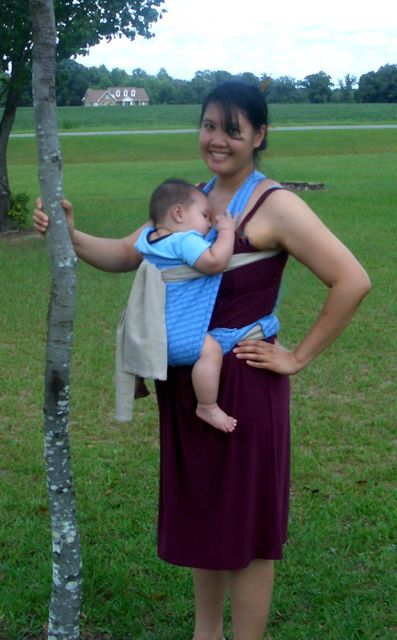
Mei Tais are very simple to make a there are a host of tutorials and instructions available on the web. I looked at a few and combined a lot of the features I liked best in the simplest Mei Tai styles. It's basically a rectangle (roughly 16x20 inches) with very long straps (60" on mine) made of double, triple, or even quadruple layers of some sort of durable but soft fabric with minimal stretch (I used a suit weight silk that I bought before I was pregnant but never used) and double or triple seams with high quality thread every where for strength. If you are very short, slender, or do use wrapping styles that require going around the waist or back twice, you can get away with shorter straps.
I'm not sure if it's my bad back, but it wasn't as comfortable as I had hoped it would be. I will try making one more in the near future and seeing if any of the modifications I have in mind help. I would definitely recommend making very wide shoulder straps (6" or more) and padding with an internal layer of quilt batting or thick fleece. My straps are about 5" and cut into my shoulders after a few minutes. I did put some padding in the main body to make it more comfy for my son, but he doesn't seem to notice it. I think I will use a cushier material for the seat pad in my next Mei Tai. Also, if you think you'll be using it a lot or have a baby who falls asleep easily, I would say to try one of the patterns that includes a sleeper hood.

Baby's verdict: He's hot natured and sometimes gets a bit over heated even though it's made out of silk and cotton. He's also in a wiggly stage and gets tired of being in it when he's in an active mood. When he's tired, he has no problem falling asleep in it but would probably stay asleep longer with a hood for keeping his head positioned. He would prefer a higher seat that allows him to nuzzle my shoulder.
Making one and using it has given me a much clearer idea of what my unique needs and wants are in a carrier, so I have some interesting plans for my next Mei Tai. When I finish it, I'll be putting up the pattern so you can make your own if you like what you see!
For anyone making a Mei Tai for the first time, here's a tip: this project will take much longer than you think it will for just being a rectangle with straps. It took about 4 hours of sewing not including the cutting and prepping. The double stitching and reinforcing take a long time. I didn't believe it when I read others saying it, but the straps truly are the most time consuming part of the project.
Thursday, August 19, 2010
Thrifty Thursday: Watch for Falling Prices
The clearance deals I mentioned a couple weeks ago at WalMart are even lower! Summer clothes prices are falling to make room for back to school and fall inventory. Rompers by Carters are as low as $3, Faded Glory Organic 3-piece sets (sleeveless onesie, t-shirt, shorts) are $3, and Garanimals single pieces (shorts, shirts pants) are as low as $1. Some styles of summer shoes are also 50% off or greater.
At Sears get an additional 30-50% off clearanced infant, toddler, and children's clothing. They also offer price matching on items if you find it cheaper elsewhere.
If you live in a hot climate where you'll get a few more months of use out of warm weather attire or want to stock up for next year, this is the perfect time!
At Sears get an additional 30-50% off clearanced infant, toddler, and children's clothing. They also offer price matching on items if you find it cheaper elsewhere.
If you live in a hot climate where you'll get a few more months of use out of warm weather attire or want to stock up for next year, this is the perfect time!
Tuesday, August 17, 2010
DDT 8 -- How to Make Prefolds for Free!
There are many items around your home that can be repurposed or recycled to make diapers before you throw them away. Using a serger or a reinforced zig zag stitch, you can have a sizable collection of prefold diapers using items you may have thought had outlived their use.
Items that make great diapers:
T-shirts
Sweatshirts
Flannel or cotton knit pajamas
Fleece blankets
Fleece pullovers
Hand towels
Bath towels
Soft woven cotton fabrics like well-worn, lightweight twill
Just about anything soft, absorbent, 80% or more cotton big enough for a diaper
What to do:
For lighter weight fabrics like flannel or t-shirts, I've had the best results using 2-3 layers and sewing a soaker pad in between them made of a doubled layer cut from an old towel or fleece. Another approach is to use 2 layers with 4-6 soaker layers of t-shirt material or flannel.
For heavier fabrics, like towel weight material or fleece, I've found that 1-2 layers with a 1 layer soaker is sufficient.
Cut the fabric for the size you need (measurements below). Position outside layers with the wrong sides facing inside. The soaker should be about 1/3 the width of your diaper, centered and positioned as the middle layer.
Using a straight stitch, sew through all layers of the diaper down both sides of the soaker pad lengthwise. Go around the outer edge of the diaper with a serger or reinforced zig zag stitch. Trim loose threads. You're done!
*Sizing:
Preemie (up to 7 lbs)
9.5" x 13"
3" x 13" soaker
Newborn (4-9 lbs)
9.5" x 14"
3" x 14" soaker
Infant (7-15 lbs)
12" x 16"
4" x 16" soaker
Regular (13-35 lbs)
14.5" x 21"
4.5" x 21" soaker
Toddler (25+ lbs)
17" x 23"
5" x 23" soaker
*These are the standard dimensions of the most common prefold sizes. The weights are very flexible. My 20 pound 6 month old can still use preemie size prefolds, but they are low-rise and not absorbent enough for sleeping or napping unless they are doubled in a heavy duty cover. When my son was in the suggested weight range for infant prefolds, I had to fold down the front up to 6 inches to make it fit inside the cover, which added a lot of bulk to the front. I still have need 3-4 inches of front fold when I use infant size. Even the preemie size had to be folded down 1-2 inches until he was about 4-5 months old. I recommend using the preemie or newborn dimensions for most babies under 15 pounds for a slimmer fit and a lower rise. In fact, I would suggest shortening the diaper to 12" for babies under 10 pounds if you are trying to achieve a more custom fit.
Items that make great diapers:
T-shirts
Sweatshirts
Flannel or cotton knit pajamas
Fleece blankets
Fleece pullovers
Hand towels
Bath towels
Soft woven cotton fabrics like well-worn, lightweight twill
Just about anything soft, absorbent, 80% or more cotton big enough for a diaper
What to do:
For lighter weight fabrics like flannel or t-shirts, I've had the best results using 2-3 layers and sewing a soaker pad in between them made of a doubled layer cut from an old towel or fleece. Another approach is to use 2 layers with 4-6 soaker layers of t-shirt material or flannel.
For heavier fabrics, like towel weight material or fleece, I've found that 1-2 layers with a 1 layer soaker is sufficient.
Cut the fabric for the size you need (measurements below). Position outside layers with the wrong sides facing inside. The soaker should be about 1/3 the width of your diaper, centered and positioned as the middle layer.
Using a straight stitch, sew through all layers of the diaper down both sides of the soaker pad lengthwise. Go around the outer edge of the diaper with a serger or reinforced zig zag stitch. Trim loose threads. You're done!
*Sizing:
Preemie (up to 7 lbs)
9.5" x 13"
3" x 13" soaker
Newborn (4-9 lbs)
9.5" x 14"
3" x 14" soaker
Infant (7-15 lbs)
12" x 16"
4" x 16" soaker
Regular (13-35 lbs)
14.5" x 21"
4.5" x 21" soaker
Toddler (25+ lbs)
17" x 23"
5" x 23" soaker
*These are the standard dimensions of the most common prefold sizes. The weights are very flexible. My 20 pound 6 month old can still use preemie size prefolds, but they are low-rise and not absorbent enough for sleeping or napping unless they are doubled in a heavy duty cover. When my son was in the suggested weight range for infant prefolds, I had to fold down the front up to 6 inches to make it fit inside the cover, which added a lot of bulk to the front. I still have need 3-4 inches of front fold when I use infant size. Even the preemie size had to be folded down 1-2 inches until he was about 4-5 months old. I recommend using the preemie or newborn dimensions for most babies under 15 pounds for a slimmer fit and a lower rise. In fact, I would suggest shortening the diaper to 12" for babies under 10 pounds if you are trying to achieve a more custom fit.
Thursday, August 12, 2010
Thrifty Thursday: Back to School Savings for Parents
If you are a mom or a dad taking classes this fall, you may still be trying to find some or all of your text books for the term. If that's you, check out www.dealoz.com. This is the website (formerly known as www.campusi.com) that got me through my college days. I saved literally hundreds of dollars every semester by searching for my textbooks on this website. It pulls results from over 50 online bookstores and lists them from cheapest to most expensive including shipping. Happy book hunting!
Tuesday, August 10, 2010
DDT7 -- Strip Odors from Cloth Diapers (and other clothes)
Let's face it. We want cloth diapering to be all roses and sunshine because it's better for the earth and better for the baby. We even tell our non-cloth-diapering friends that we never have problems with odors in our cloth diapers. But it happens to the best of us...sometimes our cloth diapers get funky and not in a good way!
In my effort to make sure that the least possible amount of irritants touch my baby's most sensitive skin, I've learned how to strip diapers naturally, organically, and inexpensively. For those times when high heat, double and triple rinses, and sun drying don't kill the diaper smell, here's my method.
Prewash with hot water, 3/4 cup of white vinegar, and 1/4 cup baking soda. You may use more or less depending on the soil level and size of the load. You have enough of everything if the water fizzes even just a little. Wash as usual afterward.
It also works great on socks and other odor-prone clothing like work clothes and underwear, but be careful because it can cause some fading, especially when you sun dry after using this method. To strip cloth diapers organically, use organic baking soda and vinegar.
Organic vinegar is easily found in most major grocery stores. Baking soda (here comes a chemistry lesson), even though it is made of carbon (the main property of organic compounds), can technically never be "organic" because of it's chemical makeup and the type of bonds required to hold it together. From the standpoint of green living and using naturally derived products, baking soda is not really organic either because it requires a multi-step chemical process involving heat and exposure to other chemicals to create it. It is however made from naturally occurring compounds and requires no synthetic materials for the reactions from which it derived. That being said, the most "natural" and healthy baking soda, especially if you intend to ingest it, is aluminum free. Bob's Red Mill makes an aluminum free baking soda and Frontier also sells an aluminum free baking soda. Both are sold in one-pound packages.
Why does the baking soda and vinegar solution work at stripping odors? This is another chemistry lesson, but this one is easy to digest. Stinky diaper syndrome is caused by bacteria and and spoiling or deteriorating micro residues from waste (imagine a microscopic septic tank or garbage dump in the fibers--or don't because that's gross). Baking soda, an alkaline salt, chemically neutralizes odors. Vinegar, an acid, kills bacteria. The reaction created by combining them (aka the fizz), blasts and eats away dirt and residue (think of what happens when you put a rusty penny in vinegar and baking soda). This solves both the odor causing problems.
Here's to fresh smelling diapers and all your other smellier than average laundry!
photo credit: by gesinek, stock.exchng,

In my effort to make sure that the least possible amount of irritants touch my baby's most sensitive skin, I've learned how to strip diapers naturally, organically, and inexpensively. For those times when high heat, double and triple rinses, and sun drying don't kill the diaper smell, here's my method.
Prewash with hot water, 3/4 cup of white vinegar, and 1/4 cup baking soda. You may use more or less depending on the soil level and size of the load. You have enough of everything if the water fizzes even just a little. Wash as usual afterward.
It also works great on socks and other odor-prone clothing like work clothes and underwear, but be careful because it can cause some fading, especially when you sun dry after using this method. To strip cloth diapers organically, use organic baking soda and vinegar.
Organic vinegar is easily found in most major grocery stores. Baking soda (here comes a chemistry lesson), even though it is made of carbon (the main property of organic compounds), can technically never be "organic" because of it's chemical makeup and the type of bonds required to hold it together. From the standpoint of green living and using naturally derived products, baking soda is not really organic either because it requires a multi-step chemical process involving heat and exposure to other chemicals to create it. It is however made from naturally occurring compounds and requires no synthetic materials for the reactions from which it derived. That being said, the most "natural" and healthy baking soda, especially if you intend to ingest it, is aluminum free. Bob's Red Mill makes an aluminum free baking soda and Frontier also sells an aluminum free baking soda. Both are sold in one-pound packages.
Why does the baking soda and vinegar solution work at stripping odors? This is another chemistry lesson, but this one is easy to digest. Stinky diaper syndrome is caused by bacteria and and spoiling or deteriorating micro residues from waste (imagine a microscopic septic tank or garbage dump in the fibers--or don't because that's gross). Baking soda, an alkaline salt, chemically neutralizes odors. Vinegar, an acid, kills bacteria. The reaction created by combining them (aka the fizz), blasts and eats away dirt and residue (think of what happens when you put a rusty penny in vinegar and baking soda). This solves both the odor causing problems.
Here's to fresh smelling diapers and all your other smellier than average laundry!
photo credit: by gesinek, stock.exchng,
Monday, August 9, 2010
Cool Mom's Final Word on Car Seats
I've been researching safety seats for a while because he hit 18 lbs at 4.5 months, and I was like, "Ok...time to figure out what to do next..." The whole car seat issue just fills me with righteous indignation at the way manufacturer's capitalize on parents' legal obligation to meet minimum safety standards by requiring you to buy 3-5 safety seats to get them through the 80 pound mark required by many states.
At best, the median weight for 1 year old boys is 23 pounds, so the "standard" infant car seat, which stops at 22 pounds won't even get you through a year if you have a boy. If you're one of those people who want to buy a travel system, about 75% of them come with 22 lb seats but 35+ lb strollers. The highest weight I've seen on a travel system car seat is 30 lbs.
Next there's the law. Just about every state I know of goes by the NHTSA guidelines for infants which is 22 lbs AND 1 year in a rear-facing seat with a 5-point harness. Many states like Virginia strictly go by the NHTSA height and weight requirements for older children regardless of age: 40 pounds before switching to a booster (age 4 suggested), and 80 lbs AND 4'9" (age 8 suggested) before going to a plain seat belt. I would hate to be a 4'5" 12 year old in Virginia. Georgia is more lenient. They require all children six and under to be in a restraint "appropriate for their weight and height".
The first reason to for these guidelines is physiological. Even though an child is a certain height or weight, they are still at a certain stage of development based on their age. Infants and toddlers have fragile bones. Their skulls aren't fully hardened until around age 3, which is why rear facing car seats are the safest for as long as you can do it as they greatly diminish the force of impact (a physics lesson in and of itself) and a large part of what protects your internal organs during heavy impact is toned and developed musculature. Infants and small children obviously don't have that.
The next reason has to do with physics but I'll forgo the lesson here as well. It is recommended that infants and toddlers under 40 pounds be restrained with a 5-point harness because a properly fitted 5-point harness diffuses the impact across the rib cage rather than across the abdomen and pelvis as a 3-point harness or lap and shoulder belt would. The largest reason for child injuries and fatalities in car accidents is not the actual impact, but injuries caused by an ill-fitting harness or putting too small of a child in a 3-point or adult seat belt. Common injuries include pelvic fractures and abdominal strictures.
Now we have cost versus value versus convenience.
Since child product manufacturers want to rape parents for all they're worth, most people end up needing to upgrade their infant car seats when their child is between 5-9 months unless they got a 30-pound car seat. That means you need a rear-facing car seat that can transition to forward facing in order to get the most "value". This is known as a convertible car seat. You can try to be smart and get a convertible car seat for a newborn since most of them claim to be good starting with 5 pounds, but a car seat that can accommodate a 40+ pound toddler ends up swallowing newborns without lots of extra accessories to ensure proper fit and support. The good news is that you can get a 40-pound convertible car seat for $35-40 (Cosco Scenera Convertible Car Seat). Pay a little more, and you can get the Evenflo Tribute for $60 which accommodates a taller child. For even more ($70-100), you can get something in Evenflo's Titan series which has a maximum weight limit of 50 pounds, but is strangely a slightly shorter car seat than the Tribute. It is supposedly good for children up to 50" tall, but I've read many reviews from parents saying that their children outgrew the Titan car seats in the 30 something inch range. For costing 2x or more than the least expensive convertible car seat, I think it better last as long as it's supposed to. You can pay up to $150 for a low-mid price range convertible car seat, but the max weight is 65 pounds on these and they are HUGE--not great if you have a small vehicle or frequently ride with passengers. For the $150-250 price range you can get a convertible or 3-in-1 car seat that turns has a booster mode for children up to 100 pounds. Most of these are huge as well--the bigger the kid, the bigger the seat.
Want to know how much a forward-facing only seat costs? The least expensive toddler seat appropriate for 1 year olds that I've found is the Cosco high back booster, which is forward-facing for 22-40 pounds and a belt-positioning booster seat for 40-80 pounds. It costs $49 even at walmart.com. That will get you through even the strictest state requirements.
If you don't have special needs, the least expensive way to go is to get a cheap convertible car seat, then a forward facing seat when they outgrow it, and a $15-20 backless booster afterward if they need it. If your convertible car seat allows you to go straight to a booster mode, you can get a high back booster for little kids for as low as $30. But this route requires up to 4 separate seats, which isn't convenient and carbon footprint decreasing and all of that. If I wasn't constantly having to spend money elsewhere, I'd spend more upfront and get the most compact convertible car seat with the highest weight capacity I could find rather than having to buy so many additional seats. During my car seat search, my favorite has been the Recaro ProSERIES because they're compact, have a high maximum weight capacity, and are made in the USA as opposed to China where all the other car seats are made. They also seem to be the safest because they have really high standards and put their focus on safety and convenience and ease of use as far as making height adjustments.
If you're curious about which car seat I got, I picked the Evenflo Tribute. I was strapped for cash and had to put aside my preferences and ideals so that my little man would have something ride in. The features are pretty good: high user ratings, two position recline, latch equipped (safest and easiest way to install a car seat, compatible with most cars manufactured from 2002 on), body and head pillows, fold down cup holder, and able to withstand about twice the impact as the minimum federal crash safety standards. I wish it had a higher weight and height limit, but my son should be about a year and a half before he reaches 40 pounds because babies and toddlers slow down a lot with the weight gain from 6 months on. At that point, I'll have more flexibility in choosing the style of car seat , and maybe I can afford the one I like then.
My car seat will come in between 8/12-8/17. I'll tell you all about it when it comes!
I hope this helps some people in their car seat search.
Tuesday, August 3, 2010
DDT6 -- The Scoop on Poop
I know the biggest turn off to cloth diapering is probably the poop factor. The fact of the matter is that your baby may not even poop as often or as copiously as you imagine. In addition to your infant or toddler's age, diet (down to the brand of milk) will also affect the quantity, consistency, and frequency of the bowel movements.
The Good News
While it is ideal for a newborn to poop 4-8 times a day, it is not uncommon for it to be quite less. The nurses at the hospital told me that any decent size "mark" could be considered a bowel movement. Once my son got into a routine, he only had 1-2 dirty diapers a day and often went up to 3 days at a time between poops. This is normal and should not be thought of as constipation unless it is coming out hard and/or dry. Breastfed babies can go up to a week without pooping because breast milk is so perfectly made for an infant's digestive system that almost 100% of it can be absorbed with no waste material. Even formula fed babies can go up to 3 days between bowel movements without concern, and there are a handful of formulas that compare with the digestibility of breast milk.
More Good News
As your infant ages, the consistent of the bowel movements will change and become easier and easier to remove from the diaper. If you are blessed with a little bundle of joy who happens to be a prolific pooper, the frequency will also decrease to about 4 times a day at 4 months and down to one time a day by 6-8 months. In many cases, this could happen sooner. My son has been making well-formed stools since around 4 months. It might be hard at first to deal with, but it does get better!
The Bad News
Newborn poop is very sticky and can have an almost liquid-like texture. This will make it messy to prewash out of the diapers until they start having more solid bowel movements at about 4 months. If you have to, the good old fashioned washing in a basin works, but it's not the most palatable way to deal with poopy diapers. The easiest way is with a sprayer (even later on). It knocks off the poop without mashing it into the cloth for the least amount of residue on the diaper. You don't have to get an official diaper sprayer. If you have a mud room with a shower stall or a sink with a built in sprayer, that will save you money and the trouble of installing an extra gadget. Once you rinse it, wring out as much water as you can and put in the diaper bucket until you're ready to launder.
So there you have it. That's the scoop on poop. It's not as scary as it seems, so get to it!
Thursday, July 29, 2010
Thrifty Thursday: Great Sales on Kids' Clothes and New Coupons
Head to TheChildrensPlace.com for deep discounts on items in their summer sale. Items start at $2.99 and are great for back to school clothing or stocking up for next summer. With $5 shipping on every order no matter what size, it's worth checking out.
Kmart.com has great deals on baby and toddler items right now. Get 10% baby and toddler gear, furniture, and bedding. If you're looking for clothes, their sale items start as low as $1.79 on polo shirts, onesies, shorts, and more. Plus get an additional 10% off these prices on all Little Wonders brand clothing and free shipping on all orders over $49.
As always, check out my coupon banner which can be found in my Thrifty Thursday posts and my blog's side bar for savings on Huggies diapers, wipes, groceries, and more!
Kmart.com has great deals on baby and toddler items right now. Get 10% baby and toddler gear, furniture, and bedding. If you're looking for clothes, their sale items start as low as $1.79 on polo shirts, onesies, shorts, and more. Plus get an additional 10% off these prices on all Little Wonders brand clothing and free shipping on all orders over $49.
As always, check out my coupon banner which can be found in my Thrifty Thursday posts and my blog's side bar for savings on Huggies diapers, wipes, groceries, and more!
Tuesday, July 27, 2010
DDT5 -- Choosing Diaper Fabric
There are a few things to consider when selecting fabric for a diapers. The two main characteristics you want to think about are absorbency and comfort. The cloth needs to absorb quickly and not irritate sensitive skin in a constant contact situation.
For absorbency, I've found that bamboo fabrics are are fast and hold a lot of liquid without a lot of bulk, cottons are very absorbent but tend to be very thick, cotton flannel is absorbent even though it isn't thick but doesn't tend to be the most durable with frequent washing, and fleeces are good at wicking away moisture for the driest feel.
The most comfortable, soft fabrics I've found are bamboo blends. Bamboo velour is very soft and fluffy. Bamboo fleece is some of the most luxurious I've felt. Other benefits are the almost nonexistant shrinkage and the antibacterial properties of bamboo. Cotton is also very comfortable, especially french terry which is also a very effective liquid absorber, but some flannels and terry can be on the rough side. Fleece is hit or miss depending on what it's made out of and if it's anti-pill or not. I've used polyester fleece remnants and some of them work well, but the ones that pill leave marks on my baby's skin.
Because various types of fabric are have tactile differences and do not interact the same way with moisture, I've found that there is not really one all-purpose fabric that is perfect for every diaper project. Even though cotton, bamboo, and hemp can be very good at absorbing wetness, they aren't always good enough for heavy wetters or night time use. Fleece tends to be the best for that and polyester is the driest feeling and fastest wicking. Polyester fleece also releases waste quickly with no staining in my experience. For reusable wipes and diaper liners, I've found that having a thick side (such as terry cloth or polyester fleece) and a soft side (such as cotton knits or bamboo fleece/velour) is best. The thick side can be used for getting the bulk of the mess and the soft side for gentle clean up. When used as a liner, I like to fold it so that the soft side or the driest feeling side, depending on the fabric used, is on the outside and the most heavily absorbent fabric is on the inside. Ultimately, you'll have to decide what fabrics and combinations work best for you.
To read more about the types of fabrics people are using for diapers and the pros and cons, I found this article to be very informative:
http://www.thethreadedbranch.com/pages/newfabricsarticle.php
The most comfortable, soft fabrics I've found are bamboo blends. Bamboo velour is very soft and fluffy. Bamboo fleece is some of the most luxurious I've felt. Other benefits are the almost nonexistant shrinkage and the antibacterial properties of bamboo. Cotton is also very comfortable, especially french terry which is also a very effective liquid absorber, but some flannels and terry can be on the rough side. Fleece is hit or miss depending on what it's made out of and if it's anti-pill or not. I've used polyester fleece remnants and some of them work well, but the ones that pill leave marks on my baby's skin.
Because various types of fabric are have tactile differences and do not interact the same way with moisture, I've found that there is not really one all-purpose fabric that is perfect for every diaper project. Even though cotton, bamboo, and hemp can be very good at absorbing wetness, they aren't always good enough for heavy wetters or night time use. Fleece tends to be the best for that and polyester is the driest feeling and fastest wicking. Polyester fleece also releases waste quickly with no staining in my experience. For reusable wipes and diaper liners, I've found that having a thick side (such as terry cloth or polyester fleece) and a soft side (such as cotton knits or bamboo fleece/velour) is best. The thick side can be used for getting the bulk of the mess and the soft side for gentle clean up. When used as a liner, I like to fold it so that the soft side or the driest feeling side, depending on the fabric used, is on the outside and the most heavily absorbent fabric is on the inside. Ultimately, you'll have to decide what fabrics and combinations work best for you.
To read more about the types of fabrics people are using for diapers and the pros and cons, I found this article to be very informative:
http://www.thethreadedbranch.com/pages/newfabricsarticle.php
Thursday, July 22, 2010
Thrifty Thursday: Baby and Toddler Clothing Sales
Check the clearance racks at your local WalMart for $4 Carter's rompers in all sizes from infant to 24 months. They were so cute that I couldn't resist! I'm hoping he'll still fit in 24 months when it warms up next spring. If not, we can layer long sleeves or leggings underneath when it gets cooler or save them for the random warm days during the Georgia winter.
Head to Diapers.com for savings on all baby clothes and shoes through the end of July. Use coupon code JULYSALE for 10% off $50, 15% off $75, and 25% off $100. As always, free shipping on all orders over $49 for double savings!
And don't forget about the coupon generator to the right for savings on groceries and home products.
Head to Diapers.com for savings on all baby clothes and shoes through the end of July. Use coupon code JULYSALE for 10% off $50, 15% off $75, and 25% off $100. As always, free shipping on all orders over $49 for double savings!
And don't forget about the coupon generator to the right for savings on groceries and home products.
Tuesday, July 20, 2010
DDT 4 - DIY Cloth Diaper Supplies
Making your own cloth diapers and diaper covers isn't hard at all. You might be surprised at the materials you already have in your home like old towels or old flannel pajamas that you can repurpose for diaper making projects. It's great practice and will give you a feel for the absorbency levels of different types of fabric.
Even if you're using materials you already have, you'll probably need to supplement with a few other items to make anything outside of a basic prefold or contour diaper. Here's a list of cloth diaper making basics and some of my favorite places to find them.
Basic Supplies
Suppliers
SewShoppe.com - They have almost everything imaginable for your baby sewing needs including diaper sewing notions that are difficult to find anywhere else, but shipping is a little high so it's not ideal for small orders
CelticCloths.com - PUL, fabrics, elastics, and patterns. Great deals in their constantly changing clearance inventory. You'll want to check this regularly. Shipping as low as under $3.00 for small orders.
GreenThumbFabrics.com - They have some of the lowest prices for bamboo fabrics, but don't always have everything in stock. A good value if you're not on a time limit.
NaturesFabrics.com - The best selection of organic fabrics I've seen in one place, and the prices are reasonable. They recently added PUL to their inventory. For those with very ambitious projects in mind, they also sell some of the best priced bolts of fabric I've found thus far.
DenverFabrics.com - Huge selection of conventional cotton fabrics and fleeces and everything else you might need for your nondiaper sewing projects. Reasonable prices. Frequent sales.
Etsy and Ebay - Find diaper cuts, remnants, or full yardage of PUL, fabric, and other supplies from other DIY moms selling their extras.
Even if you're using materials you already have, you'll probably need to supplement with a few other items to make anything outside of a basic prefold or contour diaper. Here's a list of cloth diaper making basics and some of my favorite places to find them.
Basic Supplies
- Fabric (flannel, terry cloth, french terry, velour, fleece with no more than 20% polyester content)
- Elastic (1/4 inch garter, baby garter, Lastin, fold over elastic)
- Hook & Loop (Aplix, soft Velcro, touch tape)
- PUL fabric for covers and outer shell of AIOs and pocket diapers
- High quality thread (use polyester for covers and items that need to be waterproof)
Suppliers
SewShoppe.com - They have almost everything imaginable for your baby sewing needs including diaper sewing notions that are difficult to find anywhere else, but shipping is a little high so it's not ideal for small orders
CelticCloths.com - PUL, fabrics, elastics, and patterns. Great deals in their constantly changing clearance inventory. You'll want to check this regularly. Shipping as low as under $3.00 for small orders.
GreenThumbFabrics.com - They have some of the lowest prices for bamboo fabrics, but don't always have everything in stock. A good value if you're not on a time limit.
NaturesFabrics.com - The best selection of organic fabrics I've seen in one place, and the prices are reasonable. They recently added PUL to their inventory. For those with very ambitious projects in mind, they also sell some of the best priced bolts of fabric I've found thus far.
DenverFabrics.com - Huge selection of conventional cotton fabrics and fleeces and everything else you might need for your nondiaper sewing projects. Reasonable prices. Frequent sales.
Etsy and Ebay - Find diaper cuts, remnants, or full yardage of PUL, fabric, and other supplies from other DIY moms selling their extras.
Monday, July 19, 2010
Size Matters

Before I became a mother, I used to think that preoccupation with the petite was reserved for adults. I am, however, rethinking that as I've been researching exactly what it means to be in the 90+ percentile compared with the median weights for infants at various stages.
Even though my son is ahead of the curve, the median weight for a 6 month old boy is 18 pounds. This is only 4 pounds away from the maximum weight limit of infant car seats which are ideally supposed to last until the child is 1 year old. Many brands of infant clothing have a maximum recommended weight of around 19.5 pounds for 9 months sizes. It seems that baby products are designed with girls in mind who have much lower median weights. Since this is true, one would think that manufacturers would make different lines of products to accommodate the different needs of boys and girls, especially with clothing. But they don't. It's as if companies purposely under size their products so that consumers will have to purchase multiple items (often costly items) in order to span the entire period of use.
What about when it comes to play pens and the height limits on car seats? The story is much the same. I've blogged about my car seat woes, so there's nothing new there. I've also been looking at play n plays, play yards, and play pens since my son is of the age where he needs to be contained to make sure he doesn't get away when I'm not looking. The largest I've seen, however, is 34" on it's longest side, and it's not cheap. My son is already over 26" tall. That doesn't leave much room for crawling and exercise. I was extremely disappointed because I have fun memories involving the extra large playpens from the days of yore.
Because of that, I've had to search for alternatives to the traditional play pens. If you search for gate or fence style play yards, these start with dimensions of at least 36"x36" and most of them have optional extensions available for purchase. The pros are that they are convenient, versatile, highly portable, often able to be reconfigured to the shape and size that best fits the room, and cost much less per square foot than traditional style play pens. The cons are that they aren't padded in the walls, need a separate pad for the floor if your baby is still learning to sit up or crawl, and the selection and styles are limited.
In a world where manufacturer's capitalize on the fast growth of infants and small children by making products that run small and your child is already larger than average, a mom has to get creative sometimes.
Image: Rasmus Thomsen / FreeDigitalPhotos.net
Thursday, July 15, 2010
Thrifty Thursday: Sales for Crafty Moms
Since my last diaper blog was about making your own diapers, here are some current sales to make your diaper making and other craft projects lighter on the budget. Enjoy!
www.sewshoppe.com - Your one stop shop for diaper making and other baby sewing projects. They have the best selection of diaper supplies under one roof that I've found so far.
20% off entire purchase with coupon code STOREWIDE
JoAnn.com - A crafting superstore. Find even more sales at your local JoAnn.
Up to 50% off all fleece
50% off all 54" home decor fabrics
Up to 40% off all papercrafting supplies
30% off all yarn
50% off one regular price item with online code WHF198
Free shipping on all orders over $25with online code EYD198
Celtic Cloths - A cloth diaper making and information website. Find free patterns, great deals in their clearance items, and one of the lowest shipping prices out there!
www.sewshoppe.com - Your one stop shop for diaper making and other baby sewing projects. They have the best selection of diaper supplies under one roof that I've found so far.
20% off entire purchase with coupon code STOREWIDE
JoAnn.com - A crafting superstore. Find even more sales at your local JoAnn.
Up to 50% off all fleece
50% off all 54" home decor fabrics
Up to 40% off all papercrafting supplies
30% off all yarn
50% off one regular price item with online code WHF198
Free shipping on all orders over $25with online code EYD198
Celtic Cloths - A cloth diaper making and information website. Find free patterns, great deals in their clearance items, and one of the lowest shipping prices out there!
Tuesday, July 13, 2010
DDT 3 -- Free Cloth Diaper Patterns
Here are free downloadable patterns for anyone who wants to try their hand at make a few diapers. Everything from AIOs, pocket diapers, contours, fitteds, and covers!
All-in-One Pattern (Medium)
Rita's Rump Pocket Diaper - (patterns for covers, AIOs, contours, and more also available)
Little Comet Tails Not so Flat Wrap (I have personally used this pattern as a contour diaper and used it a starting point to create my own covers and AIOs. It has a very generous cut, which is great as a contour. For covers and AIOs, I have to trim it down in the crotch and/or lengthen the pattern for the best fit.)
Wee Weka Pocket Nappy (My personal favorite. It didn't start fitting that well as a pocket diaper until my son was about 4 months old as the rise was too high. Now that it does, it's a very nice slim fitting diaper even with night time stuffings. I did, however, use the pattern to make a diaper cover with an adjustable rise, and it was the only cover I had the fit well for newborn use. It still fits great even now.)
Come back next week for my favorite DIY cloth diaper supplies and suppliers!
Wednesday, July 7, 2010
Thrifty Thursday: How to Save the Planet and your Wallet on Laundry Day

1) This is probably a no brainer. Use the coolest temperature setting possible on both the washer and dryer. This will decrease the work done by the water heater and the dryer heating element. Less heat in your appliances also means less radiant heat in your home which translates into less work for the air conditioner. It's a moneysaving snowball effect!
2) Wait until you have enough for a full load before doing laundry. No matter what size load you wash, your washer and dryer use the same amount of time and energy to operate. You'll save electricity, water, and time in the long term.
3) Use a residue free soap or try reducing the amount of regular detergent you use in the wash. In many cases, you can decrease the amount of detergent by 25-50% without compromising cleaning power because of the caustic surfactants used in most detergents. If you are washing an extra dirty load, agitate then let it soak overnight to loosen the grime before running a full wash cycle. This will reduce or eliminate the need for an extra rinses when you do laundry.
4) Harness the energy of the sun to double task drying and disinfecting. If you use high heat settings in the washer or dryer for disinfecting purposes, try an old fashioned clothes line. The UV light emitted by the sun which causes sunburns is also a powerful antimicrobial death ray. You'll decrease the amount of heat needed on laundry day, which will keep your home cooler and your wallet fatter.
5) Make your dryer faster by putting a dry towel or two in the dryer. This is especially good for thick clothing and cloth diapers that dry more slowly than regular laundry. The towel will wick water out of the wet clothes, allowing them to dry more quickly. Since the towel is dry to begin with, the heat of the dryer will evaporate moisture almost immediately so that the towel can draw out wetness continuously. A word of caution: don't get too excited about this idea and overfill your dryer. The wet clothing needs to be able to tumble freely in order for this to work. Also make sure you don't use this method on clothes you want to keep lint free.
Photo by mattox courtesy of stock.xchng
Subscribe to:
Posts (Atom)